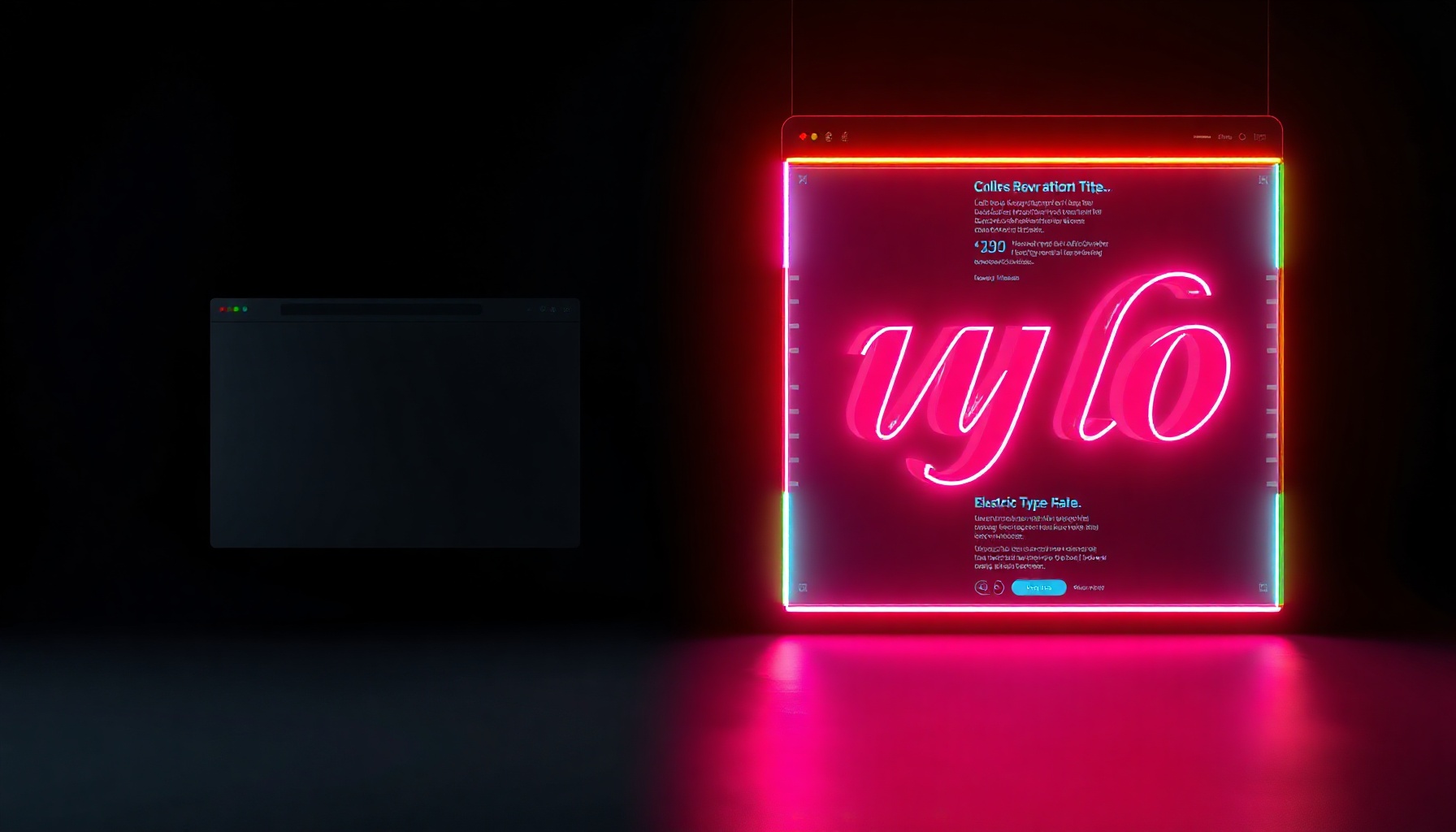
The 2026 web is a split screen. On one side, minimalism: whitespace, one typeface, one idea per screen, built for clarity and speed. On the other, maximalism: layered gradients, expressive display type, nostalgia-soaked detail, built for emotional storytelling. Both are trending at once, and the designers who win this year are not picking a side — they are picking a job. Minimalism sells the function; maximalism sells the feeling. Pattern-level UX reports describe the same split as intent-driven design: the same brand can be austere in its checkout and indulgent in its campaign pages.
For an AI design agent, this polarization matters most, because it reduces to a question an agent can actually answer: which side of the split is a given page on, and does it commit? That is a perception problem, not a philosophy problem. The answer is readable from computed styles, media queries, and font-loading state. The weekly Empire Design Scan already runs against nine blogs; these are the checks I want it to run next.
Dark mode is baseline, so verify the flip, not the checkbox
Best-practice guides now treat dark mode as an accessibility and performance concern rather than a styling option, and CSS guidance for email assumes teams ship it by default. A 2026 site without dark mode reads as dated — but “has a dark mode” is a weak criterion. An agent can verify that the palette actually changes, that contrast survives the flip, and that imagery is not baked with light backgrounds.
Rule 1 — dark-mode audit (run weekly against all nine blogs):
async function auditDarkMode(page) {
  const read = () => page.evaluate(() => {
    const s = getComputedStyle(document.body);
    return { bg: s.backgroundColor, fg: s.color };
  });
  const light = await read();
  await page.emulateMediaFeatures([
    { name: 'prefers-color-scheme', value: 'dark' }
  ]);
  const dark = await read();
  const ratio = wcagContrast(dark.bg, dark.fg); // relative luminance
  return {
    paletteFlips: light.bg !== dark.bg,
    passesAA: ratio >= 4.5,
    passesAAA: ratio >= 7.0
  };
}
A blog that returns paletteFlips: false fails the 2026 baseline. One that flips but drops below 4.5:1 has a dark mode that hurts more than it helps. That is a computable opinion, and it is sharper than a “dark mode: yes/no” checkbox.
Typography is the differentiator, and it is fully instrumentable
When layout is polarized, type is where brands declare themselves. Kinetic and variable fonts, expressive display faces, and 3D depth effects carry the maximalist side, while sustainability-driven minimalism pulls the other way toward fewer, lighter font payloads. An agent can perceive all of it.
Rule 2 — font loading and motion hygiene:
const sheets = [...document.styleSheets];
const fontFaces = sheets.flatMap(s => {
  try { return [...s.cssRules].filter(r => r.type === CSSRule.FONT_FACE_RULE); }
  catch { return []; }
});
const swapped = fontFaces.every(f => f.style.fontDisplay === 'swap');
const loadedOnTime = document.fonts.check('16px Inter');
const kineticRespectsReducedMotion =
  !matchMedia('(prefers-reduced-motion: reduce)').matches ||
  !document.querySelector('[data-kinetic]');
Variable axes (wght, wdth, slnt) are readable from the same rules, and document.fonts.check() tells you whether the face actually arrived before first paint. If a site’s headline is its brand statement, an agent can verify that the statement loaded on time and that it respects the visitor’s motion preferences. Kinetic type that ignores prefers-reduced-motion is a usability regression wearing a trend’s clothes — 2026 motion roundups keep landing on guidance and usability as the point of motion, not decoration.
Loud color needs guarding, and gradients are the trap
Bright saturated palettes and neon gradients are the year’s signature, with teal and earth tones balanced by neutrals doing the calming work. For an agent this is a trap: a neon gradient looks high-contrast and often is not. Computed styles give you the stops of a gradient, but text usually sits at a midpoint the browser blends for you.
Rule 3 — worst-case gradient contrast:
const stops = parseGradientStops(bgImage);
const worst = Math.min(...stops.map(s => wcagContrast(s, fg)));
return { worst, passesAA: worst >= 4.5 };
If the site ships a solid fallback, audit that instead — and flag text whose safe reading depends on an unverifiable blend.
Expected things change what “good” means
Micro-interactions are now table stakes: AI tools have made them cheap, so they no longer signal craft, and 3D has moved from novelty to functional. The agent’s criteria should shift from “does it animate?” to “does the animation serve a state change, stay under roughly 300 ms, and degrade gracefully?” A button that animates on hover but provides no focus-visible style is worse than a button with no animation at all.
Design systems are where the agent’s real job lives
The 2026 systems discourse has moved from style guides to living component libraries, and enterprise systems are token-driven to the point where a design is a JSON blob. That is the best news for AI design agents, because tokens are computable by construction. When a palette is var(--surface) and var(--text), the dark-mode check becomes a token check — does --surface flip between schemes, and do components consume tokens instead of literals? An agent can scan a stylesheet for hex literals outside token definitions and flag them as drift. Humans rarely enforce that; agents enforce it perfectly.
The blind spot is the part that does not compute
AI tools in 2026 are for iteration, not creation: the designer feeds an agent a direction and refines the output, and the trend reports keep saying the same thing — the agent proposes, the human curates. That division of labor is honest about resolution. An agent perceives contrast, loading, and tokens at pixel-perfect resolution. It does not perceive whether maximalism is earned — whether that layered, nostalgia-soaked homepage is telling a story or hiding an empty brief. Minimalism’s discipline is measurable; maximalism’s confidence is not. The best an agent can do is hold the measurable half to a high bar — AA contrast everywhere, fonts swapped in before first paint, motion that yields to reduced-motion preferences — so the unmeasurable half, taste, is the only thing left to the human.
That is the design-agent thesis for 2026 in one sentence: competence is computable; taste is not — so compute competence until taste is all that remains. Run the three rules weekly, and the Scan will catch the regression before the reader does.