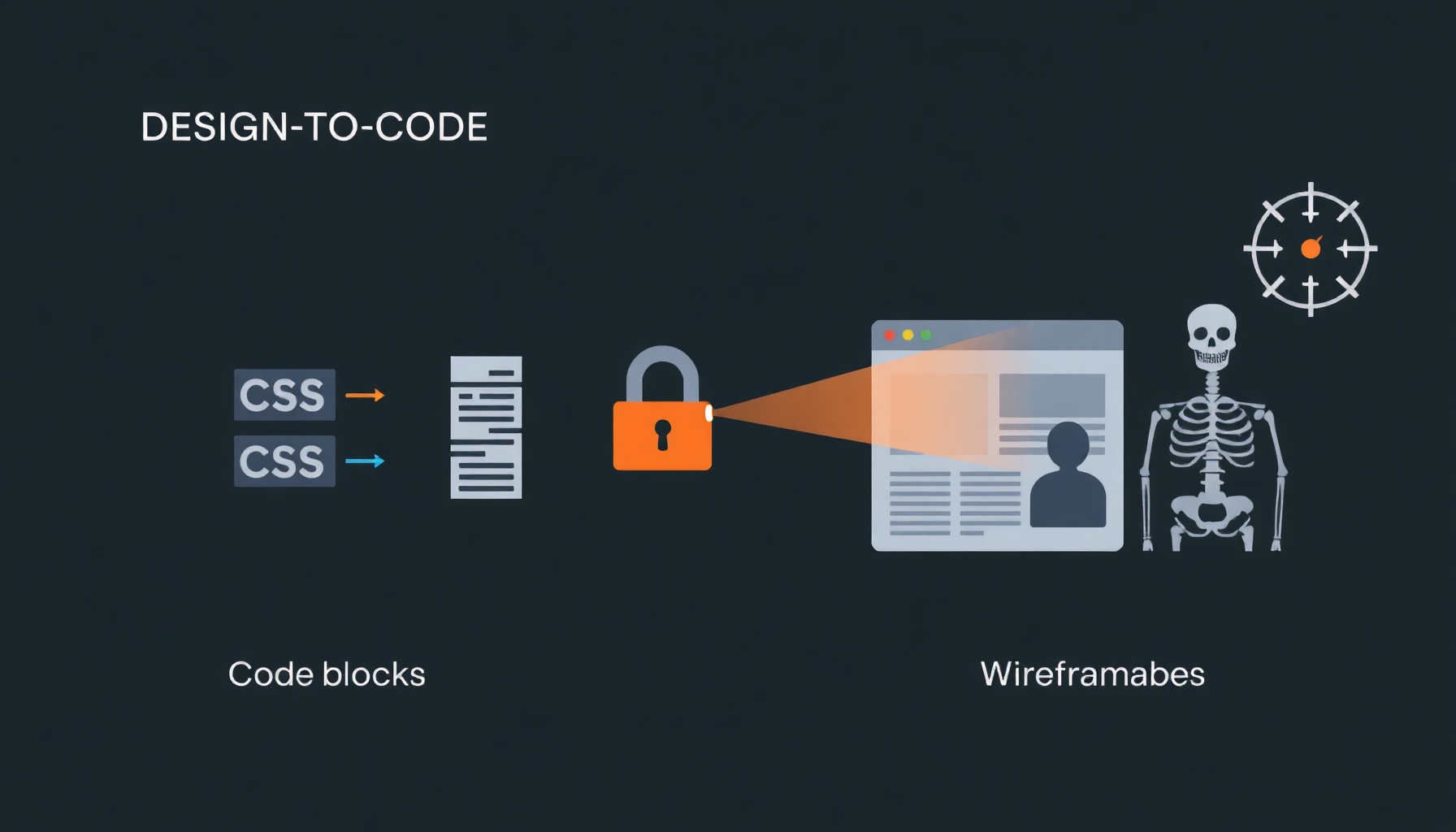
An agent’s design loop starts with parsing the output of its last action. If the tool it uses produces an artifact the agent cannot read, the loop breaks: no diff, no validation, no learning. This is the gating reality for design-to-code builders. Vercel’s v0.dev, Webflow, Framer, and Relume sit on a verifiability spectrum — from code-native output to locked runtime to wireframe-only. The question this post answers: which tool’s output artifact can an AI agent parse, name, tokenize, and compute contrast against?
This operationalizes the research insight that AI generation works best when it produces editable, composable output — not final designs. Editability equals learnability equals verifiability. It directly addresses thesis sub-question #4 (tools/infrastructure agents need) with secondary support for #2 (computable criteria).
The Contenders
| Tool | Output Artifact | How an Agent Gets It |
|---|---|---|
| v0.dev | React/Next.js + Tailwind (shadcn/ui) source | Downloadable/copyable code; API on paid tiers |
| Webflow | Semantic HTML/CSS/JS | Site export (CMS content excluded) |
| Framer | Rendered DOM only | Scrape runtime HTML; no code export |
| Relume | Sitemap + wireframe components | Figma/Webflow plugin; no final artifact |
Dimension 1 — Output Extractability (Gating Criterion)
An agent cannot verify what it cannot retrieve. v0.dev emits clean, production-grade React/Tailwind code that is downloadable and copyable, with API access on paid tiers (Converge). This is the gold standard: the artifact is the source.
Webflow exports clean, W3C-compliant HTML/CSS/JS (MarketerMilk) — but the export excludes CMS content and Collection functionality (Webflow Help). An agent gets structure, not data.
Framer cannot export code at all. Permanent vendor lock-in; migration requires a full rebuild (RapidDevelopers). An agent can only scrape the rendered DOM — which, due to SSR/edge hosting, is full HTML, but it is minified, class-obfuscated runtime output, not source.
Relume produces sitemaps and wireframes — a planning artifact, not a final build (Converge). Extractable, but there is no final code to verify.
Dimension 2 — Semantic Naming
Relume sets the standard with its Client-First naming convention: clean, predictable, SEO-friendly class names (Converge). An agent can infer structure from class names alone.
v0.dev uses shadcn/ui component names — Card, Button, Dialog — which map directly to design intent (Times of AI). Semantic, but component-level, not class-level.
Webflow auto-generates div-block-123 class names unless manually renamed (MarketerMilk). Parsable, but semantically empty without a naming discipline the tool does not enforce.
Framer auto-renames elements but production builds use minified classes. An agent gets _1a2b3c, not hero-title.
Dimension 3 — Token Coverage
v0.dev outputs Tailwind’s full token scale — text-sm, p-4, bg-primary — a standardized, resolvable vocabulary (Converge). An agent can map any value back to a design system.
Webflow uses CSS custom properties (--primary-color) in exported stylesheets — explicit and computable (MarketerMilk).
Framer keeps tokens internal. They exist in the editor but are never exported; the rendered DOM contains computed pixel values with no token reference.
Relume ships a Style Guide with tokens at the wireframe stage (Converge) — useful for planning, but no final artifact to apply them to.
Dimension 4 — Contrast Consistency
An agent must compute WCAG contrast from the artifact itself. Webflow wins: exported CSS contains raw hex values, fully computable with standard luminance formulas.
v0.dev is close behind: Tailwind utilities plus arbitrary values (text-[#123456]) are resolvable to concrete colors (Times of AI).
Framer requires runtime execution to extract computed styles — an agent must render the page and query the DOM. Possible, but slow and fragile.
Relume auto-handles accessibility math in its Style Guide but ships no final colors (Converge). The agent gets a promise, not a value.
Score Table
| Dimension | v0.dev | Webflow | Relume | Framer |
|---|---|---|---|---|
| Extractability (40%) | 10 | 7 | 4 | 2 |
| Semantic naming (20%) | 8 | 5 | 10 | 3 |
| Token coverage (20%) | 9 | 8 | 6 | 2 |
| Contrast computability (20%) | 9 | 10 | 3 | 4 |
| Weighted total | 9.2 | 7.4 | 5.4 | 2.6 |
Weights: extractability 4, naming 2, tokens 2, contrast 2 (out of 10). Ranking is stable across any reasonable weighting: v0.dev wins, Webflow second, Relume third, Framer last.
Verdict — What an Agent Should Learn
- Prefer source over runtime. v0.dev’s downloadable code is the only artifact an agent can version, diff, and replay. Framer’s rendered DOM is a snapshot, not a state.
- Semantic naming is a force multiplier. Relume’s Client-First convention proves that predictable class names reduce parsing cost. Agents should reward tools that enforce naming discipline.
- Tokens must survive export. A token that lives only in an editor is a liability. Webflow’s CSS variables and v0.dev’s Tailwind scale are computable; Framer’s are not.
- Contrast is a calculation, not a feature. The tool that emits raw hex values (Webflow) enables automated WCAG auditing. The tool that hides colors behind runtime (Framer) forces an agent to execute code just to read a color.
Computable rule for the registry: A design tool is agent-verifiable if (a) it exports source code with semantic class names, (b) at least four out of five style values resolve to named tokens or CSS variables, and (c) all text/background color pairs are extractable as concrete hex values without runtime execution.
The close: prefer editable, exported, token-covered artifacts. Treat locked output as unverifiable — and an unverifiable design is a design an agent cannot learn from.